Pages

Showing posts with label cartoons. Show all posts

Saturday, 28 March 2015

Anthropomorphism

Anthropomorphism

Fig 1 Water Colour of taxidermy Turtle
Fig 2. Pencil Sketches
Fig 3. Line drawing of Winston Turtle
Fig 4. Woodcut print of Winston Turtle
There are three main approaches to anthropomorphism; adding human traits to an object, taking a human and adding animal qualities to them or taking an animal and adding human qualities and characteristic to them. In my approach I went with the latter. After drawing a turtle for some time I understood its shape and form well enough to feel confident in using its characteristics and traits to morph them into human attributes. I looked to the taxidermy turtle trying to see what human qualities I felt were already there, and after some brainstorming I felt he had similar qualities to Winston Churchill. I had to be careful with my designs not to over exaggerate attributes as I wanted it to be an endearing tribute to Churchill and not to ridicule; an illustration not satire. By keeping the features simple and refined I felt that this kept the final image endearing yet dignified.

This endearing and charming approach is often seen throughout illustrations, particularly ones “intended” for children. This can best be seen in classic children’s illustrations, such as; Beatrix Potter’s work (Fig 5) and E. H. Shepard’s illustrations in ‘Wind in the Willows’ (Fig 6). Looking through these books I realised what made them so charming was how they selected animals that would match well with human traits and successfully portray personalities. The animals were also likable and at times cute. A good example of matching animal and human characiteristics  would be the weasels in ‘Wind in the Willows who are of course are scoundrels and villains. However sometimes unexpected animals are matched with opposite traits. Dualism was used in ‘The Wizard of Oz’, in the form of a scared lion. 

Fig 5. Beatrix Potter. The Tailor of Gloucester
Fig 6. E. H. Shepard. Wind in the Willows.

There are different ways to anthropomorphise an animal:
  •  Adding an animal head to a human body and vis versa
  • Animals acting like humans; walking on two legs, wearing clothes, language (Fig 4, Fig 5, Fig 6, Fig 7, Fig 8, Fig 9)
Fig 7. Pauline Baynes. The Lion, the Witch and the Wardrobe.
Fig 8. Stephen Collins

Fig 9. Stephen Collins
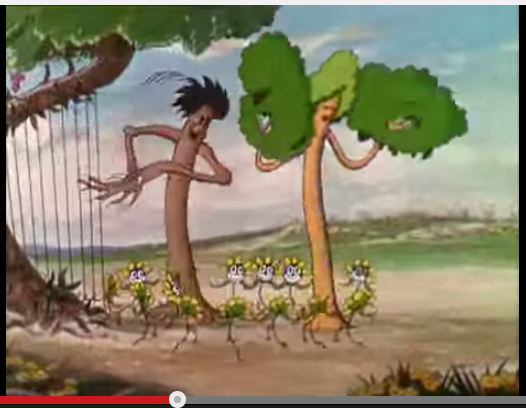
However anthropomorphism isn't just restricted to animals. Objects and the environment can also reflect human traits and characteristics. Take some of Disney’s early cartoons ‘Micky Mouse through the Mirror’ (Fig 11) made in 1936 brings to life all sorts of characters from armchairs to telephones. And in ‘Silly Symphony; Flowers and Trees’ (Fig 10) a good number of flowers and trees are brought to life and given personalities. 
Fig 10. Walt Disney. Silly Symphony; Flowers and Trees


Fig 11. Walt Design. Micky Mouse through the Mirror 
The purpose of anthropomorphism is to entertain. Whether that be through children’s books, animations, cartoons or satire. It is never intended to be taken seriously; a reflection of the real world and a reflection of the artist’s imagination.

Bibliography

Collins, Stephen. Some Comics by. London: Jonathan Cape, 2014. Print.
Grahame, Kenneth. The Wind in the Willows. London: Methuen Children's Books Ltd, 1908. Print.
Lewis, C. S. The Complete Chronicles of Narnia. London: Geoffrey Bles, 1954. Print.
Potter, Beatrix. The Tailor of Gloucester. Harmondsworth, Middlesex, England: F. Warne, 1987. Print.
YouTube. 'Mickey Mouse Thru The Mirror 1936 Toon'. N.p., 2015. Web. 28 Mar. 2015.
YouTube. 'Silly Symphony - Flowers And Trees'. N.p., 2015. Web. 28 Mar. 2015.

Friday, 27 March 2015

Satire and Political Caricature/Cartoons

Satire and Political Caricature/Cartoons

Fig 1. George Osborn Robbing the Poor and Disabled.
With all political cartoons and satire, they respond to current issues and are relevant to society. This is what I set out to achieve in my practical research. By working on these drawings I realised how aware a political cartoonist must be on current events. I have a slight interest in politics but not enough to fully understand, analyse and respond to current affairs. I feel one of the cartoons, featuring George Osborn (fig 1), is a couple of months behind the times and fails to be relevant to the here and now. It is failing to spark debate, push opinions because it is only a reflection of opinions that have already been voiced.
Fig 2. Labour and their Polices.
Although for my second drawing (fig 2) I was influenced more by another’s opinions I felt that it does have some originality in the way it is clearly and directly picking on a flaw in Labour’s political party; that I feel, to my knowledge, hasn’t been addressed directly as yet. One of the things that makes it successful is the use of familiar visual representation; by matching Ed Milband with a Jehovah Witness get up sends a message that this man and his polices aren’t to be taken seriously, particularly as they’re falling all over the place. I feel that by being a bit cheeky, lightly offensive and finding clever but simplistic ways of visual drawing attention to political issues I have entered into the mind-set of a political cartoonist and have understood what it takes for a cartoon to be effective.
What I learnt about political cartoons and cartoonist is summarised in this quote: “It (Political cartoon) is a graphic commentary on what is going on in the world…. The political cartoonist see them self as a pictorial journalist – a keen observation of the world…, curious to discover what is going on behind the scenes. … It is his task both to alert and to keep alert. … (His) aim is to expose the weakness of society in order to improve it.” [1]

Through further research I learnt the tools and visual technics that are used to create satire:
·         Caricature – exaggerated appearances to add comedic effect (Fig 3, Fig 4)
·         Comparison (often extremes) – emphasise difference for effects (Fig 5)
·         Parody – exaggerated imitation to add comic effect
·         Distortion – highlight characteristics or situation to stress an point
·         Anthropomorphism – morphing animal and human characteristics and behaviour to add humour or portray elements of personality. (Fig 6)
·        Shock – graphic violence and horror to grab readers’ attention and to emphasise seriousness

of a situation. (Fig 7)
Fig 3. Isaac Cruikshank, after Woodward, The humours of Belvoir Castle- or the Morning After (Fores 1799)
City of Laughter p145
Fig 4. Gilray, God Save the King – in a Bumper; or- an Evening Scene, Three Times a Week at Wimbleton (H.Humphrey, 1975)
City of Laughter p.124
Fig 5 Gilray, Harmony before Matrimony, Matrimony-Harmonics, (H. Humphrey, 1805)
City of Laughter p.116

Fig 6. Westminster Gazette, 14th July 1899
20th Century Studies p.31
Fig 7. Gillray, Promis’d Horror of the French Invasion, - or – Forcible Reason for Negotiating a Regicide Peace (H. Humphrey, 1796)
City of Laughter p.72

While researching it was clear to see that throughout the centuries of satire there is a boldness and brashness in the artists’ attitudes towards their work. Nothing is too rude or too offensive. Cartoonists are prepared to rub up the Nazis the wrong way or spark up a terrorist attack. All that matters is challenging public opinion to see a radical world evolving before them; a world that they (the people) can change and influence.

Bibliography
Behrendt, Fritz. 20th Century Studies; Politics in Cartoon and Caricature. Brighton: Dolphin Press, 1975
Gatrell, Vic. City Of Laughter. New York: Walker & Co., 2007. Print.